A learning-centered digital product designed to translate complex music-reading skills into short, engaging daily practice experiences.

• Date: July 2013 – April 2014
• Institution:
Peabody Institute of The Johns Hopkins University
• Principal Investigators:
Ken Johansen, MM, DMA; Travis Hardaway, DMA
• Role: Visual Designer / UX/UI Developer
Overview
For classical pianists, sight-reading is an essential but difficult skill to master. While fluent sight-readers have more performance opportunities and learn music more efficiently, traditional training often lacks structured, engaging methods that support consistent daily practice.
Read Ahead was designed to address a core challenge in sight-reading: training pianists to read ahead of where they are currently playing. The project focuses on creating a system that supports independent practice while allowing instructors to monitor progress, combining pedagogy, interaction design, and visual clarity into an accessible learning experience.
Design Challenge
How can a complex, time-based cognitive skill like musical sight-reading be transformed into short, repeatable daily exercises that are engaging, measurable, and pedagogically sound—without overwhelming the learner?
Design Approach
The project approached sight-reading as a systems problem, not just a content problem. Rather than focusing solely on musical notation, the experience was designed to reinforce habit formation, progression, and feedback.
Key design considerations included:
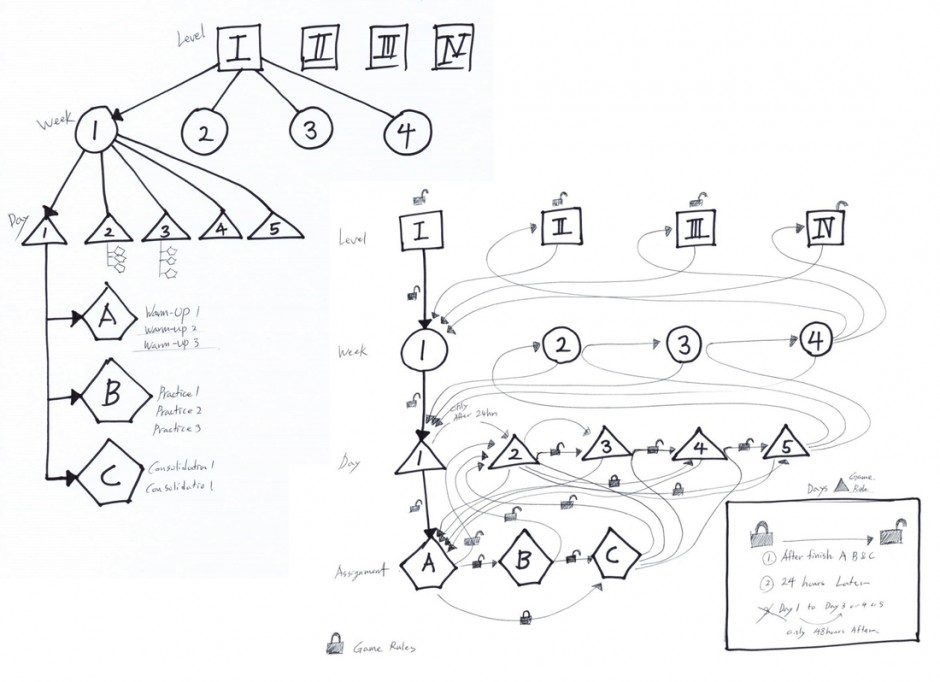
• Structuring learning into short, 5–10 minute sessions to encourage daily practice
• Using graded difficulty levels to support gradual skill development
• Designing visual and interaction patterns that reinforce anticipation and forward reading
• Balancing autonomy for students with visibility for instructors
Process & Decisions
• Developed a level-based progression system to scaffold difficulty and build confidence
• Designed interaction flows that emphasize play → score → reward, reinforcing motivation
• Created visual hierarchies that reduce cognitive load while maintaining musical accuracy
• Mapped practice behaviors into clear feedback loops to support habit formation
Rather than treating the interface as a neutral container, visual design and interaction timing were used as active teaching tools.
Outcome & Reflection
Read Ahead demonstrates how thoughtful interaction design can support learning behaviors, not just deliver content. By aligning pedagogical intent with visual structure and interaction rhythm, the system helps students build sustainable practice habits while making an abstract skill more tangible and measurable.
This project reinforced my belief that effective educational design emerges at the intersection of pedagogy, systems thinking, and human-centered interaction—not from tools alone, but from how experiences are structured over time.