A patient-centered assistive application designed to support communication, safety, and continuity of care for children with neurodevelopmental disabilities.
Accessible UX · Assistive Technology · Care-Centered Design

-
Date: April 2013 – January 2014
-
Institution: Kennedy Krieger Institute
-
Principal Investigator: Alexander H. Hoon Jr., MD, MPH
-
Role: Visual Designer / UX/UI Developer
Overview
Children with neurodevelopmental disabilities often rely on caregivers to communicate critical medical, behavioral, and personal information—especially in clinical or emergency situations. As care transitions from pediatric settings to community providers and adulthood, this information is frequently fragmented, difficult to access, or inconsistently communicated.
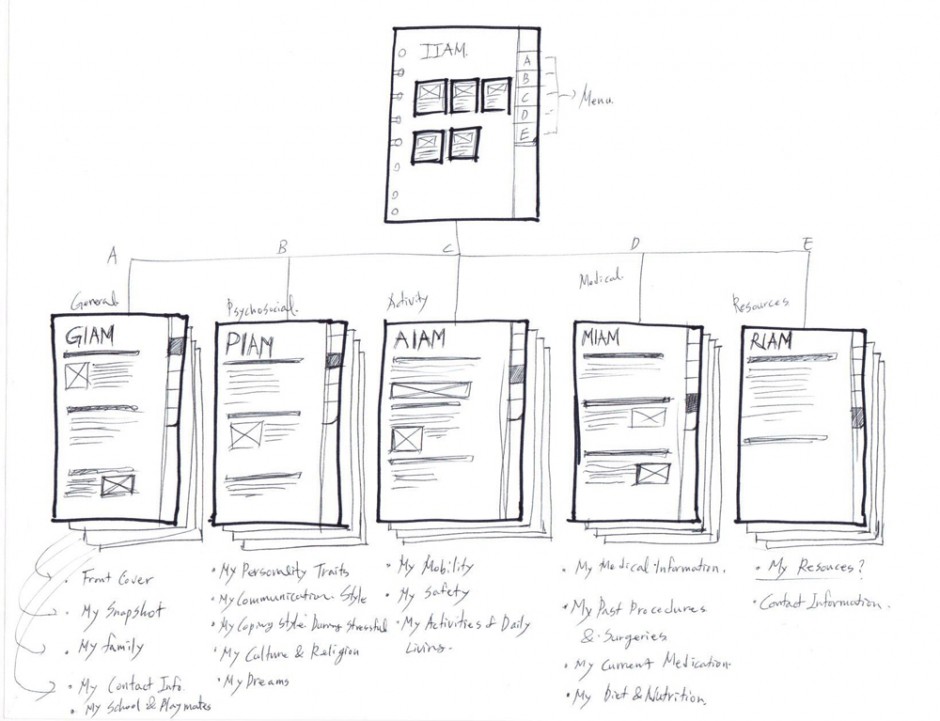
IIAM (Important Information About Me) was developed as a portable, on-device patient profile application that empowers children and caregivers by making essential information immediately accessible to both medical and non-medical professionals.
Design Challenge
How can critical personal and medical information be communicated clearly and respectfully for children with impaired communication abilities—while supporting safety, autonomy, and continuity of care across different environments?
Design Approach
The design approach centered on accessibility, clarity, and dignity. IIAM was not treated as a medical record alone, but as a communication bridge between children, caregivers, clinicians, educators, and emergency responders.
Key considerations included:
Supporting users with varying cognitive and communication abilities
Designing interfaces that reduce stress in high-pressure situations
Enabling caregivers to customize content for individual needs
Maintaining simplicity without oversimplifying essential information


Process & Decisions
Designed on-device, data-driven profiles to ensure information remained available without network dependency
Structured content into clearly labeled, visual sections for rapid comprehension
Integrated photos, videos, and visual cues to support non-verbal communication
Created explicit emergency callout pathways for urgent situations
Developed visual language and iconography to reinforce familiarity and trust
The interface emphasized predictability and clarity, allowing users and caregivers to focus on communication rather than navigation.
Outcome & Reflection
IIAM demonstrates how design can support care, safety, and agency for individuals who are often underserved by conventional digital systems. By prioritizing accessibility and communication over complexity, the application helped bridge gaps between medical and everyday care environments.
This project strongly shaped my approach to design and teaching, reinforcing the idea that human-centered design must account for ability, context, and vulnerability. It continues to inform how I approach accessibility not as a constraint, but as a core design responsibility.